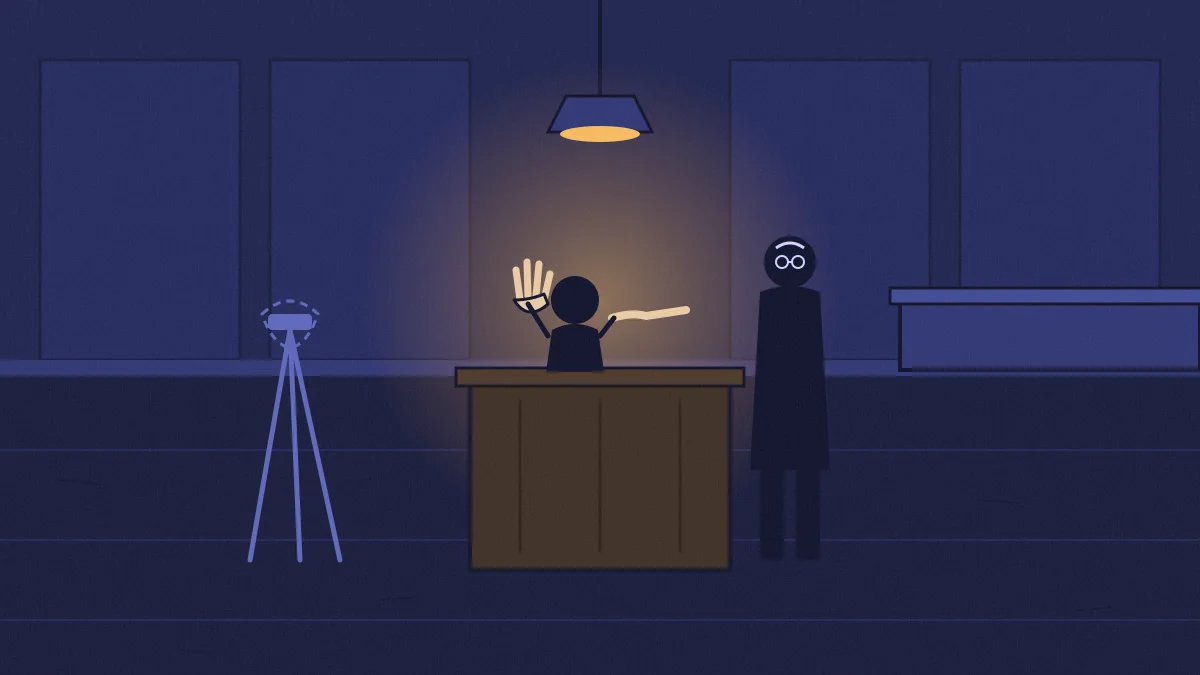
In November 2014 an eleven-year-old girl went to the fields near her village in Reasi district to cut leaves for the family's goats. She was taken to a stream and raped. Her speech is so impaired that only specialists and her family can follow it easily. When she testified in 2015, the Sessions Court used an interpreter but did not videograph her evidence. Since 2013, Section 119 of the Evidence Act has required videography for a witness who cannot communicate verbally. On 31 October 2026 the High Court held that the omission did not vitiate the convictions.
The appeal produced a split result. Rakesh Singh and Sanjeev Sharma, whom the girl identified in court, had their ten-year sentences for rape under the Ranbir Penal Code upheld. Rashpal Sharma was charged only with abetting the kidnapping but convicted of rape as well. Nothing in the girl's own evidence implicated him, and he was acquitted.
What Section 119 asks for, and why the proviso was added
Section 119 deals with a witness "unable to communicate verbally". Such a witness may give evidence in any manner that makes it intelligible, by writing or by signs, but the writing or signs must be made in open court, and the evidence is "deemed to be oral evidence". The proviso added in 2013 requires two more things: the court "shall" take the help of an interpreter or a special educator, and the statement "shall be video graphed". Section 125 of the Bharatiya Sakshya Adhiniyam carries the same text forward.
The reason for the video is in a line from State of Rajasthan v. Darshan Singh, (2012) 5 SCC 789, which the High Court quoted: the law requires a record of the signs, not the interpretation of the signs. A transcript records only what the interpreter said the witness meant. A video lets the defence, and the appeal court, check the interpreter against the witness.
| Step under Section 119 / BSA 125 | What happened at Reasi |
|---|---|
| Witness's competence tested (s.118 IEA / s.124 BSA) | Court put preliminary questions and was satisfied; no oath given because of her condition |
| Interpreter or special educator | Yes: the principal of a school for hearing-impaired children, trained in 1977, sworn to translate impartially |
| Signs made in open court | Yes; she pointed to and held the hand of the accused she identified |
| Statement videographed | No |
| Interpreter cross-examined | No. Summoned on the defence's request, but evidence was closed because he was elderly and could not attend |
The High Court also corrected the trial court's description of her. She was not "deaf and dumb". She could hear. She had severe stammering, misarticulated speech, borderline intellectual ability and sight in only one eye. Using a teacher of the deaf for a hearing witness with a speech disorder is itself worth noticing. The proviso offers a "special educator" as an alternative to an interpreter, and the choice should fit the disability.
Mandatory word, curable breach: how the Court reasoned
The Court accepted that the proviso was breached. It held the breach not fatal for four reasons:
- No objection at the time. The defence did not complain while she was being examined, and two of the three accused cross-examined her.
- No prejudice pleaded. In their statements under Section 342 of the J&K Code (the counterpart of s.313 CrPC, now s.351 BNSS) the accused said only that she was lying. Even in appeal they did not say they had been unable to cross-examine her properly.
- The interpreter is not a witness of fact. His job was to translate. The court had tested his competence and independence on oath before he began.
- Irregularities without injustice are cured. In Shivanarayan Kabra v. State of Madras (1966), a failure to interpret evidence for an accused was held a mere irregularity, cured by the old Section 537 CrPC, because no prejudice was shown. Its successor is s.465 CrPC, now s.511 BNSS.
Her disability, the Court said, "cannot be a disability of the Court to decipher the truth".
The conviction did not rest on her words alone. The forensic report found semen and blood on her shalwar, and her father explained the four-day delay in reporting by the remoteness of the village. The Court also drew on Patan Jamal Vali v. State of A.P., (2021) 16 SCC 225, where the Supreme Court warned both against treating disabled women as helpless and against discounting their testimony because of their disability.
The question the judgment leaves open
"Shall" in a procedural provision is not always mandatory. Courts ask what the provision is for, whether it prescribes a consequence for breach, and whether the breach caused prejudice. The High Court applied that test in the usual way. But the videography proviso is unusual, and that creates a difficulty a good answer should point out.
The proviso exists so that a mistranslation can be detected. The Court asked the accused to show prejudice. Without a video, and without being able to cross-examine the interpreter, how could they show the translation was wrong? The safeguard that would have revealed the prejudice is the one that was missing. The Court's answer, in effect, is that the accused never claimed a mistranslation, and the identification in court was by pointing and touching, which needs no interpreter. On these facts that is a fair answer. In a case where the conviction turns on interpreted words alone, the same reasoning would be much weaker. The Supreme Court has not yet ruled on whether the proviso is mandatory in that situation.
Part of the record supported the defence. In 2022, the prosecution itself applied under Section 540 of the J&K Code (s.311 CrPC, now s.348 BNSS) to re-examine the victim and the interpreter, saying her evidence had not been recorded under Section 119. The High Court treated this as an attempt to cure a procedural defect, not an admission that her evidence was false. Trial courts should take the lesson: video equipment costs far less than a decade of appeals arguing about what a child's gestures meant.
Charged with abetting kidnapping, convicted of rape
The third appellant's case is a short lesson on charges. Rashpal Sharma was charged only under Sections 363 and 109 RPC (abetment of kidnapping), yet the trial court convicted him under Sections 363 and 376. A court may convict of an offence not charged only where the provisions on doubtful or included offences permit it: Sections 221 and 222 CrPC, now Sections 244 and 245 BNSS. Rape is not a minor offence included in abetment of kidnapping. The High Court acquitted him on the evidence, because the girl never named him and the other witnesses did not link him to the rape. Either reason alone would have sufficed.
Then and now: the provisions in this case
- Offences: the offence was in 2014, when J&K had the Ranbir Penal Code and its own CrPC, and the central POCSO Act did not extend there. Today: rape of a girl under twelve falls under BNS s.65(2), kidnapping under BNS s.137, and POCSO applies.
- Evidence: Section 118 IEA → BSA s.124 (competency); Section 119 IEA → BSA s.125 (witness unable to communicate verbally, with the videography proviso).
- Procedure: statement under s.164-A J&K CrPC (s.164 CrPC, now BNSS s.183); s.540 → s.311 CrPC → s.348 BNSS; s.342 → s.313 CrPC → s.351 BNSS; s.537 (old) → s.465 CrPC → s.511 BNSS.
MCQs on witnesses who cannot speak
- Documentary evidence
- Deemed to be oral evidence
- Admissible only if corroborated
- Hearsay unless the witness can write
Answer
(b). The section deems it oral evidence. Writing is preferred if the witness can write (Darshan Singh, 2012).
- Record the evidence only through a magistrate
- Exclude the evidence unless the witness can write
- Record the statement through the prosecutor
- Take the assistance of an interpreter or special educator and videograph the statement
Answer
(d). In Sanjeev Sharma (2026) the J&K HC held that failure to videograph, without demonstrated prejudice, did not vitiate the conviction.
- Only if a charge for rape is framed and he has an opportunity to meet it
- Yes, since rape is a minor offence included in kidnapping
- Yes, if the victim names him in her Section 164 statement
- Yes, under Section 311 CrPC
Answer
(a). Sections 221–222 CrPC (now 244–245 BNSS) allow conviction without a charge only for doubtful or included offences. Rape is neither in relation to abetment of kidnapping.