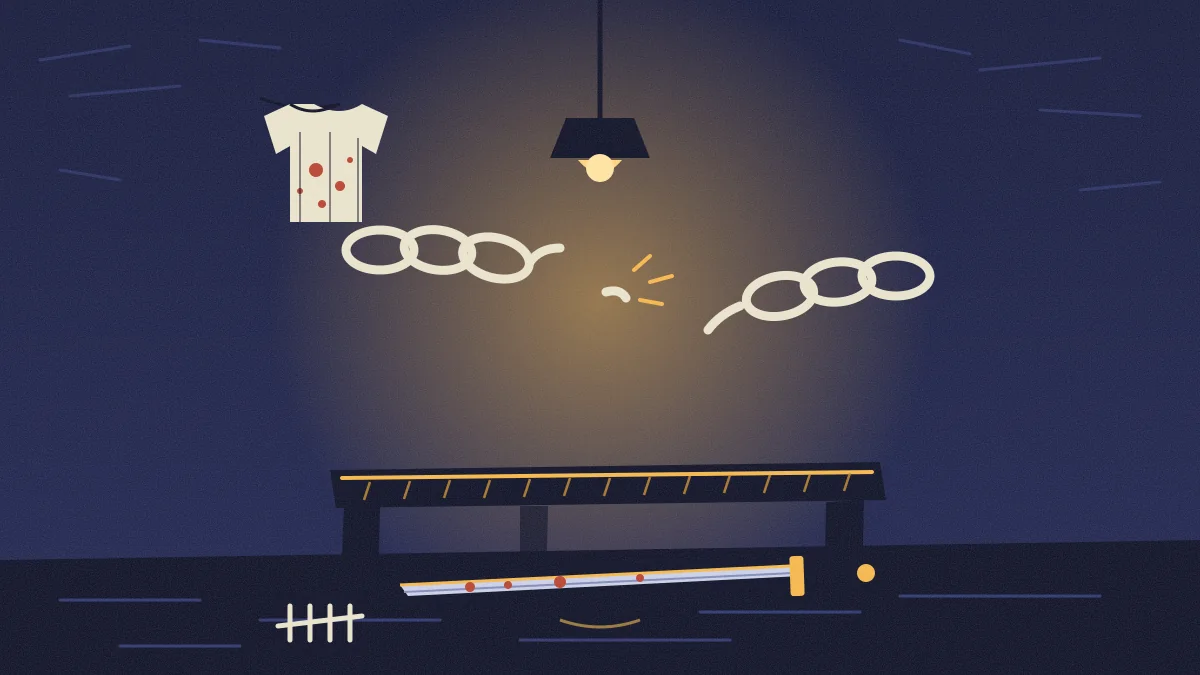
Hari Chand was found dead in a lane beside a government school in Sultan Puri on the evening of 13 October 1998, with about twenty wounds on his head, neck, chest and back. Five days later the police arrested three men. The Additional Sessions Judge decided his only eyewitness was no eyewitness, and still convicted two of them of murder with the help of a sword, a shirt and a thumb. On 5 November 2026 the Delhi High Court set both convictions aside, and the way it did so is a clean lesson in how a circumstantial case is allowed to fail.
A sword, a shirt and a stitched thumb
- 13 Oct 1998 Body found; no eyewitness at the spot. FIR under Section 302 IPC.
- 18 Oct 1998 Yashpal, Banarsi Dass and Virender arrested. Disclosure statements, a sword recovered from under a cot at Banarsi Dass's house, a pointing-out at Wazirabad Bridge where clothes were said to have been thrown (not recovered).
- Same day, at the station Yashpal's shirt and trousers are seized as bloodstained; his left thumb carries a stitched wound.
- 8 Dec 1998 / 31 May 1999 The post-mortem doctor says two injuries were possible with the sword; the forensic report finds human blood of the deceased's group on the sword and on Yashpal's clothes.
- 31 Jan 2002 Conviction under Section 302 read with Section 34 IPC; life imprisonment and a fine of Rs 2,000 each. Virender gets the benefit of doubt.
- 5 Nov 2026 Acquittal on appeal.
The trial judge found no last-seen evidence, and held that Ratan Lal, the dead man's brother-in-law, had not behaved like a man who watched a killing: he raised no alarm, did not chase anyone, and went to tell relatives. What remained was the sword, Yashpal's shirt, and the thumb, which the judge called a "strong circumstance" matching Yashpal's disclosure that he cut himself when Banarsi Dass struck the blow.
When the eyewitness goes, the case changes shape
The High Court agreed that Ratan Lal had not seen the incident and added that he was an interested witness too. That finding changes the standard. A conviction meant to rest on a seen attack now rests on inference. The Court put it plainly: once the eyewitness is not believed, the case "would fall in the realm of circumstantial evidence", and the chain "must be so complete as to lead only to the hypothesis of guilt".
Our evidence commentary lists the tests that sit behind that sentence: the circumstances must be proved, they must point exclusively to guilt, and there must be none consistent with innocence. Suspicion, however strong, does not take the place of proof, and where two inferences are equally open the one favouring the accused is taken. The Court did not weigh the circumstances as a bundle. It tested each link separately and then asked what was left to hold the bundle together.
What the discovery proviso lets in, and what it lets out
The sword was the main plank, so the High Court began with the law on recovery. Sections 25 and 26 of the Indian Evidence Act bar confessions to a police officer and confessions in police custody. Section 27 is the exception. Under the Bharatiya Sakshya Adhiniyam these are Section 23(1), Section 23(2) and the proviso to Section 23, and our chapter on confessions maps them. The Bench set out three ingredients: the information must lead to the discovery of a fact that is its direct outcome; only the part distinctly connected to that discovery is admissible; and the fact discovered must relate to the offence.
The Court then borrowed from Ramanand @ Nandlal Bharti v. State of Uttar Pradesh, (2023) 16 SCC 510, which describes the ideal procedure: independent witnesses called to the police station, the exact words of the accused recorded in the first part of the panchnama, and the recovery recorded in a second part. The same passage adds that a missing independent witness does not by itself taint the discovery; the court then weighs the investigating officer's evidence "on its own worth".
Three witnesses to a recovery, and none who could prove it
The disclosure of Banarsi Dass was witnessed by SI Vinay Singh, Ratan Lal and Vijay, the dead man's brother. Each failed in a different way.
| Witness | What he said | Why it could not carry Section 27 |
|---|---|---|
| Ratan Lal (brother-in-law) | The accused made disclosures; the sword was found under a cot at Banarsi's house. | Never said what the disclosures were; saw the sword first at the police station; interested witness. |
| Vijay (brother) | Denied any disclosure, discovery or pointing-out in his presence. | Turned hostile; nothing left to rely on. |
| SI Vinay Singh (police) | Disclosures were recorded in Ex. PW-8/A, 8/B and 8/C; the sword and clothes were recovered. | Alone on the point; and on Yashpal's clothes he could not recall where they were seized. |
Ratan Lal's account that the police party "went to the house of Banarsi from where a sword was recovered from under the cot" did not satisfy Section 27 as explained in Ramanand, because the exact information given was never proved. Counsel for Banarsi Dass made the same point through Raja Khan v. State of Chhattisgarh, 2025 INSC 167: the information has to be proved, not merely that the accused led the police somewhere. Our chapter on hostile witnesses has a section on hostile witnesses and recovery evidence.
Five days in the same shirt
The clothes fared worse. The prosecution said Banarsi Dass threw his clothes off Wazirabad Bridge. Yet Yashpal was said to have worn a bloodstained shirt for five days without washing it or changing it, which the Bench called "very improbable". The police took the accused to Banarsi Dass's house, then to the bridge, and noticed no blood on Yashpal during any of it. Only on returning to the station did the officers spot stains. The seizure memo records that the stains "looked like blood", but the head constable who signed it said he had not noticed any blood.
Discrepancies of this kind "cast a grave doubt" on the disclosures and on both recoveries.
A blood group is a category, not a signature
Suppose the recoveries had stood. The forensic report found human blood of group B, the deceased's group, on the sword and on Yashpal's clothes. The post-mortem doctor said two injuries were "possible" with this weapon or a similar one. The High Court held that this could not lead to a finding beyond reasonable doubt that the sword was the weapon of offence.
It leaned on a line of Supreme Court authority, all as quoted in the judgment: State of Rajasthan v. Hanuman, 2025 SCC OnLine SC 1387, which relied on Raja Naykar v. State of Chhattisgarh, (2024) 3 SCC 481, and Allarakha Habib Memon v. State of Gujarat, 2024 INSC 590, which in turn quotes Mustkeem alias Sirajudeen v. State of Rajasthan. The rule from that line is simple. A blood-stained weapon with the victim's blood group does not, in isolation, link the accused to the murder; it must be connected to the killing by the accused.
Two facts made the gap wider here. The deceased had about twenty injuries, including several incised wounds, and the prosecution never explained how the rest were caused. The doctor linked only injuries 1 and 2 to the sword, and only as a possibility. Counsel added that no fingerprints were lifted from it. Counsel's point that group B is "a very broad classification" was not answered by the prosecution. Expert opinion is relevant under Section 39 BSA, but relevant is not conclusive.
A thumb that was already there
The trial court read Yashpal's disclosure about the thumb as a Section 27 discovery that was corroborated by the stitched wound. The High Court reversed this. A wound on a hand is visible to anybody who looks. It was not a fact "discovered" only because Yashpal spoke, so the proviso had nothing to work on. What remained was his own statement linking the wound to the offence, and a confession to the police is inadmissible without that link. Two medical examinations could give no opinion on the age of the injury or the weapon that caused it.
Motive helped the State only up to a point
There was a motive of sorts. The deceased's mother spoke of a quarrel over Banarsi Dass's sister, and the prosecution said Yashpal, as his friend, joined in.
The Court's response was that motive "acts as a double edged sword". It can complete a chain, and it can also explain why a person with a grievance is the easiest one to accuse falsely. It found motive for Banarsi Dass and "maybe also" for Yashpal, but without "other dots to connect", it could not show that "it could only be the appellants" who killed him. The Court also noted that the trial judge had given Virender the benefit of doubt on the same evidence, while convicting the other two.
Where the old code ends and the new one begins
The trial was under the old codes, so the judgment speaks mostly in the old vocabulary; it keeps the acquitted men's bail bonds alive for six weeks under Section 481 BNSS. For answers written today, the mapping is below.
| Point | Old law | New law |
|---|---|---|
| Murder; common intention | Sections 302, 34 IPC | Sections 103(1), 3(5) BNS |
| Police confession; custody confession; discovery | Sections 25, 26, 27 IEA | Section 23(1), 23(2) and the proviso to Section 23 BSA |
| Motive, preparation, conduct | Section 8 IEA | Section 6 BSA |
| Expert opinion | Section 45 IEA | Section 39 BSA |
| Hostile witness | Section 154 IEA | Section 157 BSA |
| Examination of the accused | Section 313 CrPC | Section 351 BNSS |
Counsel for Yashpal also argued there was no evidence of a meeting of minds under Section 34. The Bench did not reach that, as the chain failed earlier; our chapter on common intention and common object explains why Section 34 needs proof of participation in a shared plan.
What the judgment leaves unsettled
The Court did not hold that a police witness alone can never prove a discovery; Ramanand allows a court to rely on the investigating officer "on its own worth", and SI Vinay Singh failed that test on these facts. Nor was the five-day gap before arrest the ground of decision; it fed into the improbability of the shirt. Nothing here changes the law. It applies it, and shows how a strong forensic story fails when its witnesses cannot hold it up.
Practice
1. An accused in police custody tells the officer: "I killed Hari with this sword and hid it under the cot at my house." The sword is found there. Under the proviso to Section 23 BSA (Section 27 IEA), what may be proved against him?
- the whole statement, since it is made in custody and amounts to a confession
- only that he killed Hari, since that is the fact in issue
- only so much as relates distinctly to the discovery, that is, that he hid the sword under the cot
- nothing, because a statement made to a police officer is never admissible
Answer
(c). The proviso admits so much of the information as relates distinctly to the fact discovered. The admission of killing is not part of that, so (a) and (b) are wrong, and (d) ignores the proviso altogether.
2. The only eyewitness is disbelieved. A sword recovered at the instance of the accused bears human blood of the same group as the deceased. No other circumstance links the accused to the killing. Following the line of authority applied in this case, the court should hold that:
- the matching blood group on the weapon, in isolation, is not sufficient to link the accused with the murder
- the matching group is sufficient, because forensic evidence is conclusive
- the matching group is sufficient if the post-mortem doctor says the weapon could have caused some injuries
- the matching group is sufficient if any motive is shown
Answer
(a). A blood-stained weapon with the victim's group does not by itself connect the accused with the murder; it must be tied to the killing by the accused, and a doctor's "possible" does not do that. Nor does a bare motive.
3. In a murder case resting wholly on circumstantial evidence, which statement about motive is consistent with this judgment?
- proof of motive alone is enough to convict
- absence of motive requires acquittal in every case
- motive is irrelevant under the Bharatiya Sakshya Adhiniyam
- motive may complete the chain but may also explain a false implication, so it cannot replace missing links
Answer
(d). The Court called motive a double-edged sword. It is relevant under Section 6 BSA but cannot make up for links the prosecution has not proved.